


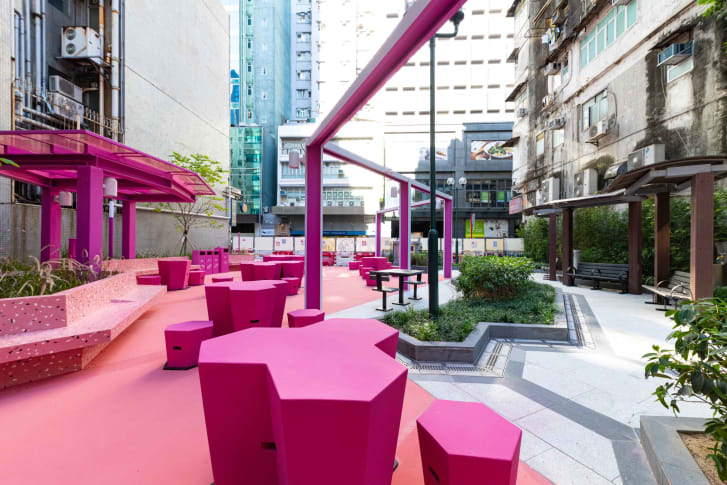
Bright pink and scattered with octagonal stools, Portland Street Rest Garden is an Instagrammer’s dream. But this park, wedged between two high rises on a bustling Hong Kong street, isn’t filled with influencers posing for photos: instead, local retirees play checkers on fuchsia gameboards, while elderly neighbors gossip on the rose-colored benches, purple grass swaying in the planters behind.
While 75% of Hong Kong’s territory, which includes more than 200 islands, is made up of lush jungle and country parks, urban Hong Kong is short on space. Its residents have just 2.7 square meters (29.1 square feet) of public space per person, according to non-profit think tank Civic Exchange — compared to 5.8 to 7.6 square meters (62.4 to 81.8 square foot) per person in other dense Asian metropolises like Singapore, Tokyo, and Shanghai. There’s a correlation between access to nature and good mental health, with people living closer to public open spaces reporting less anxiety than those living further away.
Parks like the one on Portland Street can therefore offer a reprieve from the compact towers most people live in.
Its eye-catching design is the result of a makeover by Design Trust, a non-profit that supports design-based programs. The organization has been redesigning four of the city’s micro parks in a bid to make a “macro transformation” to public space, said Marisa Yiu, co-founder and executive director of Design Trust.


More Stories
Beyond the Visible Edge: Karang Bengang as Spatial Liminality and an Ecological-Ritual Network in Balinese Customary Space
A Russian Parks Program Creates Over 350 Public Spaces and Nurtures Local Design Talent
Cairo is becoming unwalkable